

- What is Whimsical?
- Getting started with flowcharts
- Getting started with mind maps
- Getting started with wireframes
- What can you do with Whimsical?
- Using Whimsical Boards
- Working with Whimsical’s infinite canvas - video guide 🎥
- 5 ways to create a new file
- Getting started with Whimsical AI
- How to create a new workspace
- How to use AI-assisted mind mapping
- Customizing file and folder icons
- Mentions in Whimsical files
- Customizing diagram shapes
- Getting started with sequence diagrams
- Using the command menu
- Commenting in Whimsical files
- Getting started with flowcharts
- Getting started with mind maps
- Getting started with wireframes
- Using Whimsical Boards
- Mentions in Whimsical files
- Customizing diagram shapes
- Using sections on the Whimsical canvas
- Sketch on the canvas with freehand drawing
- Annotating files for more detail
- Text-to-object pasting options
- Adding and displaying links in Whimsical files
- Linking to sections and objects
- How to draw a line
- How to filter selected objects
- Presenting in Whimsical
- Using the timer in boards
- Working with the grid and auto-alignment
- Working with connectors
- Does Whimsical have cloud architecture icons?
- Using tables in Whimsical
- Using sticky notes in boards
- Optimizing performance in larger boards
- Using spellcheck
- Setting custom thumbnails
- How overlays work in Wireframe mode
- Hiding cursors while collaborating
- Measure between objects in Boards
- Uploading files to Whimsical
- Getting started with sequence diagrams
- Working with Mermaid code in Whimsical
- How to create a new workspace
- Requesting file access
- Workspace discovery settings
- Sorting files and folders
- Changing workspace members’ roles
- Adding and removing members
- Creating and managing teams
- Requesting workspace editor access
- Linking between files
- Member roles in Whimsical
- How to delete a workspace
- How to upgrade your workspace
- Guest access
- Changing your workspace name, logo, or URL
- Offboarding users
- Consolidating workspaces
- Uploading files to Whimsical
- Organizing your work with tabbed folders
- SAML
- Setting up SAML session expiry
- Security
- Prevent new workspace creation
- Customizing file and folder icons
- How to draw a line
- How to filter selected objects
- Does Whimsical have cloud architecture icons?
- How overlays work in Wireframe mode
- Moving and copying files
- Using Whimsical on mobile
- Does Whimsical have a dark mode?
- File version history
- Why are the colors of some elements toned down?
- Does Whimsical support offline mode?
- Teams, workspaces & sections explained
- Does Whimsical work on iPad?
- Free viewers commenting in workspaces
- Whimsical desktop app
- Is Whimsical available in other languages?
- Inverting the zoom direction in Whimsical so it works more like Sketch
- Troubleshooting issues and reporting bugs
- How to add emojis
- Team FAQs
- How to restore deleted files from the trash
- Searching in your Whimsical workspace
- Organizing files in your workspace
- I’ve upgraded but still don’t have access to the paid features
- Why can't I edit my files?
- Reporting content in Whimsical
- Does Whimsical have an affiliate or referral program?
- Collaborating with others in real time
- Sharing files and managing access permissions
- Hiding cursors while collaborating
- How to switch between workspaces
- Sharing feedback and feature requests
- Markdown support in Whimsical
- Embedding & integrating boards with Jira Issues
- Integrating Whimsical with Google Docs
- Embedding files in ClickUp views
- Embedding files in Asana
- Embedding Whimsical files
- Whimsical AI Diagrams for ChatGPT
- Creating Jira & Confluence Smart Links for Whimsical Files
- Embedding files in Guru
- Embedding files in Trello
- Embedding & integrating boards in Notion
- Integrating Whimsical and GitHub
- Embedding files in Zendesk
- Support Whimsical embeds in your app with EmbedKit
- Whimsical previews and notifications in Slack
- Embedding files in Canva
- Integrating Whimsical and Linear
- Embedding files in Nuclino
- Embedding files in Monday
- Embedding files in Medium
- Embedding files in Slab
- Embedding files in Coda
- Whimsical API (Beta)
- Whimsical desktop MCP (beta)
- Whimsical Remote MCP
- SAML
- SAML SSO in Whimsical
- SAML SSO with Okta
- SAML SSO with Auth0
- SAML SSO with OneLogin
- SAML SSO with Microsoft Entra ID (Azure AD)
- SAML SSO with Google Workspace (previously G-Suite)
- SAML SSO with Active Directory Federation Services (ADFS)
- SAML SSO with other identity providers
- Setting up SAML session expiry
- Managing email changes with SAML and SCIM
- SCIM
- Setting up SCIM with Okta
- Setting up SCIM with JumpCloud
- Setting up SCIM with Entra ID (Azure AD)
- SCIM provisioning with Groups in Okta
- SCIM user provisioning in Whimsical
- SCIM provisioning with Groups in Entra ID (Azure AD)
- Security
- Setting up Two-factor Authentication (2FA)
- Prevent new workspace creation
- Whitelisting Whimsical domains
- Signing in with your Whimsical account on multiple devices
- Contact us
Working with Mermaid code in Whimsical
Mermaid is a text-based diagramming syntax that lets you describe flowcharts and sequence diagrams in code.
You can paste Mermaid code directly onto a Whimsical board as an editable diagram. You can also copy flowcharts and diagrams as Mermaid to paste into other Mermaid-compatible tools.
Paste Mermaid code as a diagramCopied!Link to this section
You can paste Mermaid code directly into a Whimsical board as an editable flowchart or sequence diagram. This is handy for bringing in diagrams from docs, GitHub, or anywhere else you've got Mermaid code.
To paste Mermaid code:
- Copy your Mermaid code from wherever it lives.
- In a Whimsical board, hit
Command+V(Mac) orControl+V(PC) - We’ll automatically recognize the Mermaid syntax and render it as a diagram.
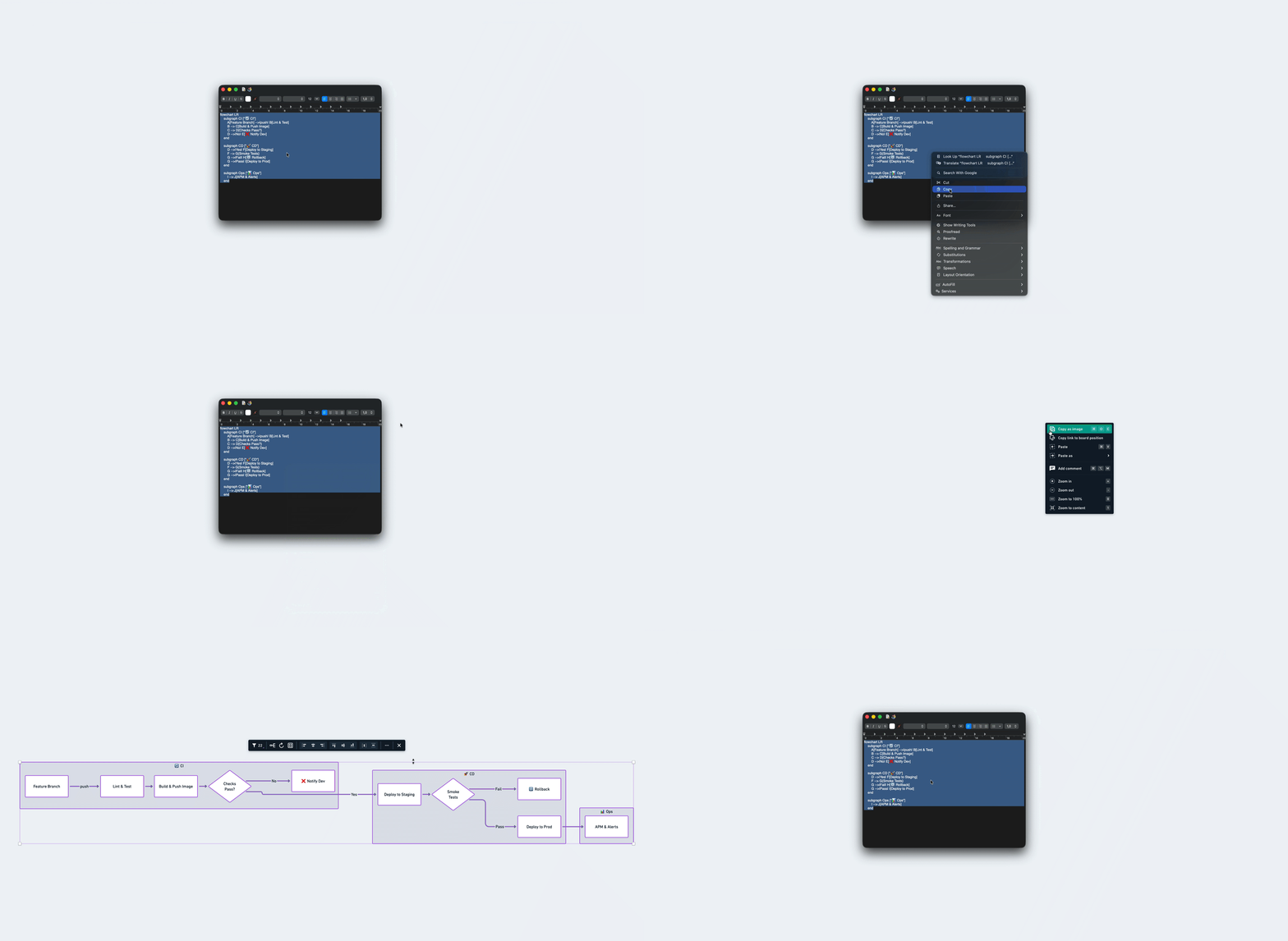
Whimsical supports both flowcharts (graphs), and sequence diagrams for import.
Copy a diagram as MermaidCopied!Link to this section
You can export any flowchart or sequence diagram back out as Mermaid code for use with GitHub, Notion, GitLab, or other tools that render Mermaid code.
To copy a diagram as Mermaid code:
- Select the flowchart or diagram you want to export.
- Right-click the selection and choose Copy as Mermaid from the context menu.
- Paste the Mermaid code wherever you need it.
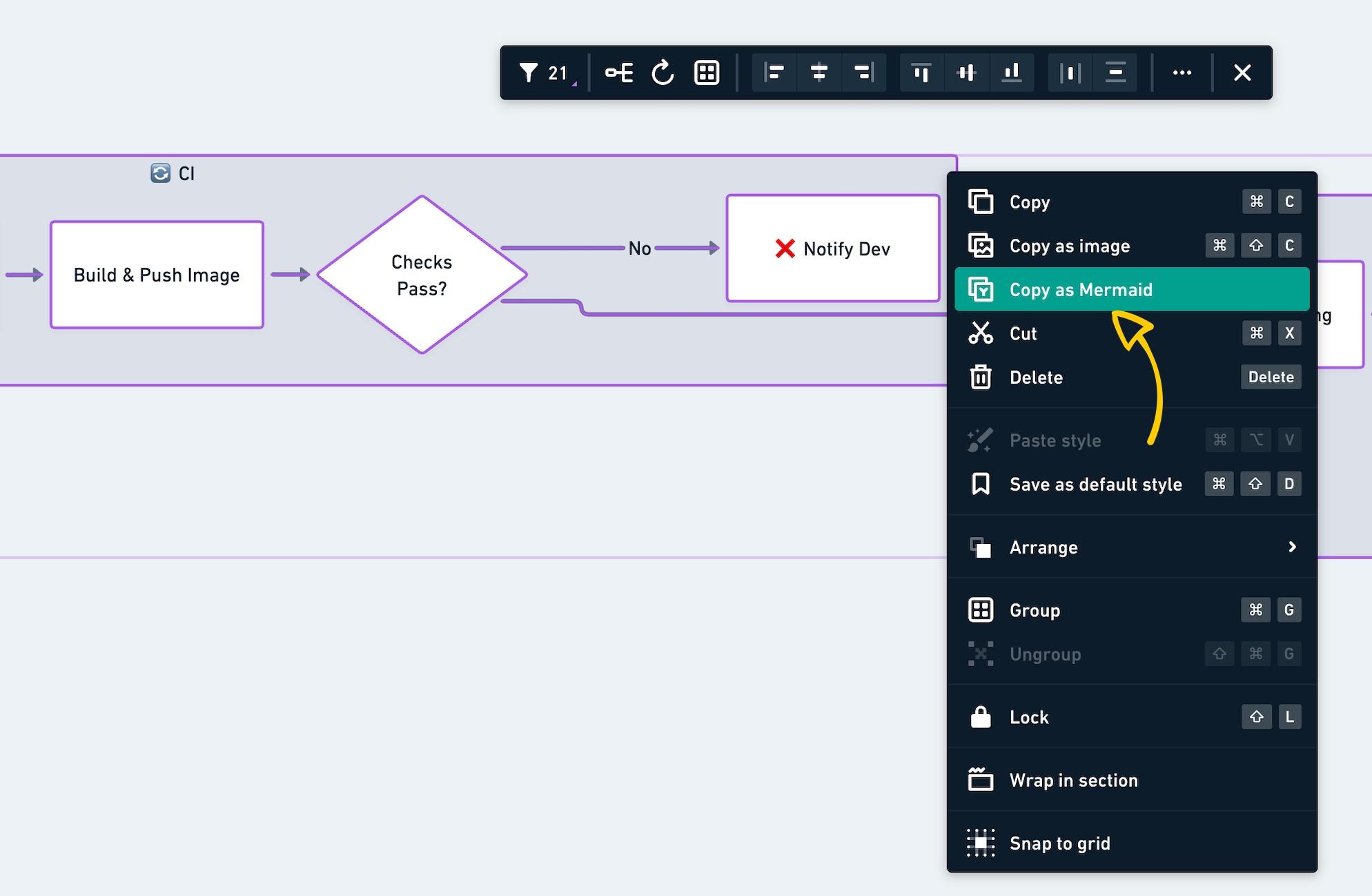
The exported code preserves the color and styles of your shapes and connectors.
Nodes are output in topological order, so the code flows in the same direction as your diagram. This ensures compatibility with how tools like GitHub use text ordering to influence layout.
Horizontal and vertical layoutsCopied!Link to this section
Mermaid supports multiple flow directions, and Whimsical honors all of them when you paste or generate a diagram:
- TB top to bottom (TD “top down” is also supported)
- LR left to right
- RL right to left
- BT bottom to top
To get a horizontal diagram, just make sure your Mermaid code specifies the direction. For example, with "flowchart LR" at the top of your code:
If you're generating a flowchart with Whimsical AI, you can specify the layout direction in your prompt. For example, "Create a left-to-right flowchart of the user onboarding process."
SubgraphsCopied!Link to this section
Subgraphs let you group related nodes together inside a larger flowchart. In Whimsical, subgraphs map to grouped and nested shapes, so the visual hierarchy in your Mermaid code carries over directly into your board.
Subgraphs are supported across all three Mermaid workflows:
- Pasting — subgraphs in pasted Mermaid code are rendered as grouped shapes on the board
- AI generation — Whimsical AI and coding agents can include subgraphs in generated flowcharts
- Copy as Mermaid — grouped shapes on your board are exported as subgraphs in the Mermaid output
Note: Using different directions inside individual subgraphs isn't currently supported. The whole diagram must use a single layout direction.
Supported Mermaid syntaxCopied!Link to this section
Here’s a reference for the Mermaid syntax Whimsical supports when importing or generating diagrams.
Flowchart node shapesCopied!Link to this section
[text]- Rectangle{text}- Diamond (decision)([text])- Pill / stadium((text))- Circle / ellipse{{text}}- Hexagon[(text)]- Cylinder
Connectors and edgesCopied!Link to this section
—>- Arrow—>|Label|- Labeled arrow=⇒- Thick arrow←→- Bidirectional arrow-.-- Dashed line;-.→- Dashed arrowx—x- Diamond endpointso—o- Circle endpoints~~~- Invisible edge (rendered as a normal connector)A & B —> C & D- Multi-node connections
Styling nodes and connectorsCopied!Link to this section
classDef className fill:#hex,stroke:#hex- Define a style class:::className- Apply a class inline to a node (requires a matching classDef)linkStyle 0,1,2 stroke:#hex- Color specific connectors (0-based index)linkStyle 3 stroke:#hex,stroke-dasharray:5 5- Dashed connector
Note: Inline :::className annotations are supported when used alongside a classDef definition. Without a matching classDef, the annotation will be ignored — but the rest of the diagram will still paste correctly.
Sequence diagramsCopied!Link to this section
participant Alice- Define a participantAlice→>Bob: message- Solid arrowBob—>>Alice: response- Dashed arrow
Use coding agents to build Mermaid diagrams with the MCPCopied!Link to this section
If you use a coding agent like Claude, Cursor, or Windsurf, you can connect it to Whimsical via the Whimsical MCP server. Then your coding agent can generate Mermaid diagrams and build them directly in your Whimsical workspace, without any copying and pasting.
This is a powerful tool to generate architecture diagrams, flowcharts, or sequence diagrams from code, specs, or prompts. For example, you could ask your coding agent to:
- "Generate a flowchart of this authentication flow and add it to my Whimsical board"
- "Create a sequence diagram of the API calls in this file"
- "Map out the data model from this schema as a flowchart in Whimsical"
To try it out, check out the related articles 👇
Related articles
Written by:

Summary
- Working with Mermaid code in Whimsical
- Paste Mermaid code as a diagram
- Copy a diagram as Mermaid
- Horizontal and vertical layouts
- Subgraphs
- Supported Mermaid syntax
- Flowchart node shapes
- Connectors and edges
- Styling nodes and connectors
- Sequence diagrams
- Use coding agents to build Mermaid diagrams with the MCP